
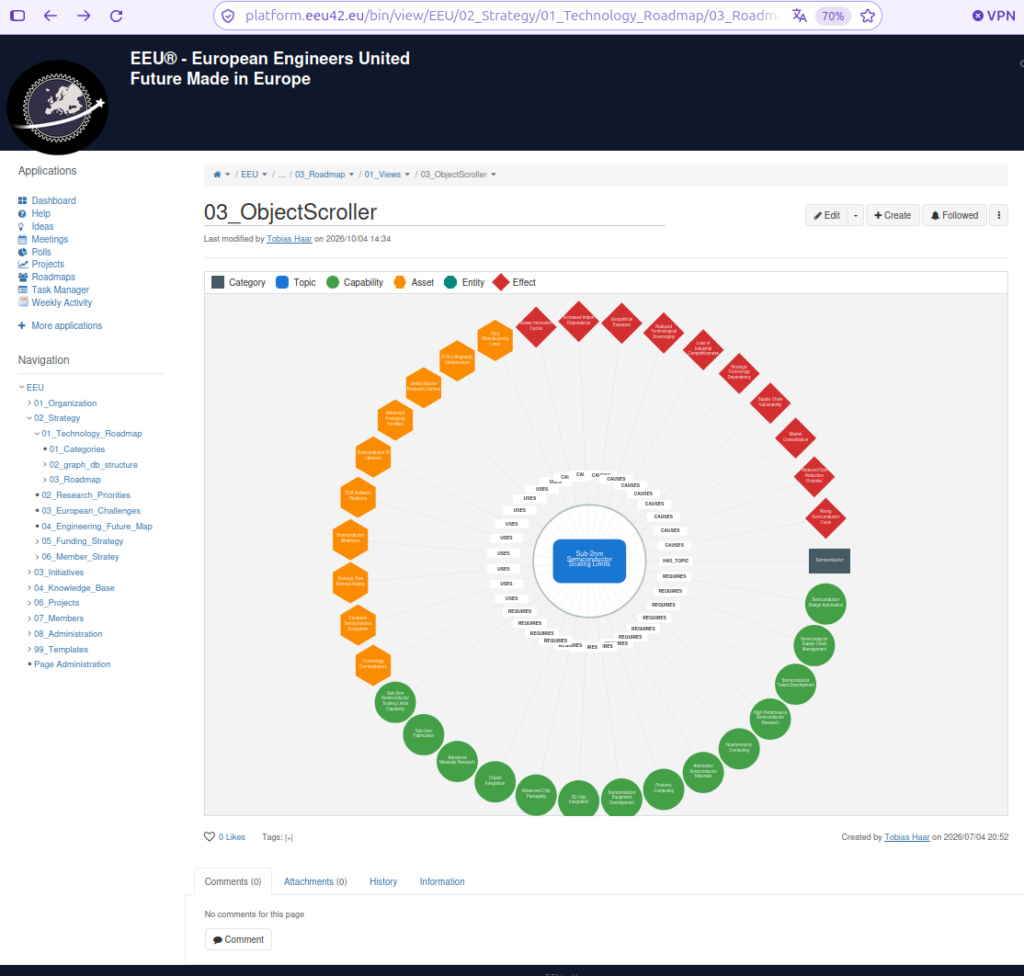
From Discussion to Roadmap: Successfully Testing the EEU Technology Roadmap Framework with Sub-2nm Semiconductor Scaling
At European Engineers United (EEU), we believe that Europe’s technological future should be shaped by engineers, researchers, and industry experts working together.
Over the past weeks, we conducted one of the first practical tests of our technology roadmap framework and selected a highly relevant topic for Europe:
Sub-2nm Semiconductor Scaling Limits.
Why This Topic?
Semiconductors form the foundation of modern society. Artificial intelligence, automotive systems, telecommunications, aerospace, defense technologies, industrial automation, and consumer electronics all depend on increasingly powerful chips.
However, as the industry approaches process nodes below 2 nanometers, fundamental physical and economic challenges are becoming apparent:
- Rising fabrication costs
- Increasing complexity of manufacturing processes
- Dependence on advanced lithography technologies
- Talent shortages
- Supply chain concentration
- Strategic dependence on a small number of global players
Understanding these challenges is essential for developing a long-term European technology strategy.
Putting the EEU Roadmap Framework to the Test
Rather than conducting a traditional discussion, EEU members and invited experts used the EEU Roadmap Framework to perform a structured technology analysis.
The framework enabled us to:
- Define the central challenge
- Identify related capabilities
- Map required assets and infrastructure
- Analyze dependencies and relationships
- Evaluate strategic impacts and risks
- Place development activities on a long-term timeline
Using the graphical roadmap tools, we built a comprehensive view connecting:
- Semiconductor design automation
- Supply chain management
Semiconductor talent development - Advanced materials research
- Advanced packaging technologies
- Chiplet integration
- Photonic computing
- Neuromorphic computing
- European manufacturing capabilities
- EUV lithography infrastructure
The result was not just a collection of ideas but a connected technology ecosystem showing how different developments influence one another.
First Results
The exercise confirmed that the roadmap framework is capable of transforming expert discussions into structured knowledge.
Several important observations emerged:
- Europe possesses critical competencies in semiconductor technology but remains exposed to strategic dependencies.
- Future competitiveness will require investment not only in fabrication facilities but also in software, research, education, raw materials, and supply chain resilience.
- Emerging technologies such as chiplets, advanced packaging, photonics, and alternative semiconductor materials could play a decisive role beyond traditional transistor scaling.
- Long-term planning requires understanding relationships between technologies rather than analyzing isolated topics.
Most importantly, the framework helped identify knowledge gaps and future investigation areas that deserve deeper analysis.
This Is Just the Beginning
The semiconductor workshop was only one test case.
The EEU Roadmap Project aims to systematically analyze many of the technological challenges and opportunities that will shape Europe’s future, including:
- Artificial Intelligence
- Robotics
- Energy Systems
- Nuclear Fusion
- Space Technologies
- Autonomous
- Transportation
- Quantum Technologies
- Advanced Manufacturing
- Cybersecurity
- Biotechnology
Our goal is to create a continuously evolving technology roadmap that helps engineers, researchers, companies, and decision-makers understand where Europe should focus its efforts.
We Need Your Expertise
The success of this first roadmap exercise demonstrated the potential of collaborative technology analysis.
But one topic is only the beginning.
We are looking for engineers, researchers, scientists, entrepreneurs, and industry experts who would like to contribute their knowledge and help analyze additional technology areas in depth.
If you are passionate about the future of technology in Europe and would like to participate in roadmap workshops, expert discussions, or technology assessments, we would be delighted to hear from you.
Together, we can build a clearer picture of Europe’s technological future.
Interested in joining?
Contact European Engineers United (EEU) and become part of the discussion.
membership registration
Future Made in Europe.
# supported by ai